Product Description
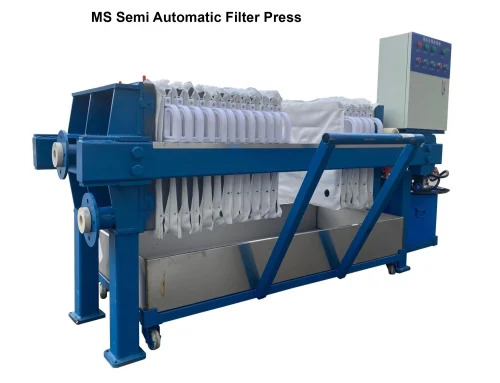
Product details
|
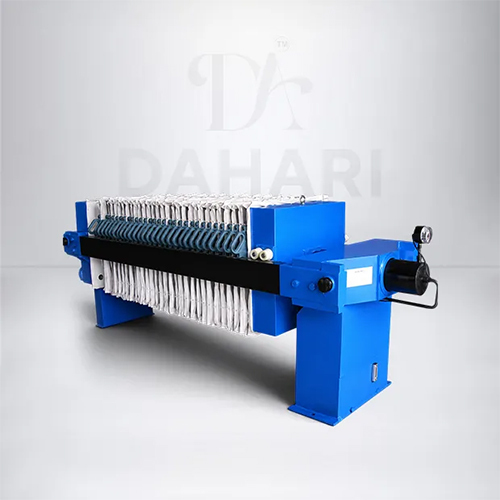
No Of Plates
|
20
|
|
Filtration Capacity
|
1000 litres/hr
|
|
Automation Grade
|
Manual
|
|
Color
|
Blue
|
|
Usage/Application
|
Industrial
|
|
Material
|
Non Woven
|
|
Filter Type
|
Suction Filters
|
i
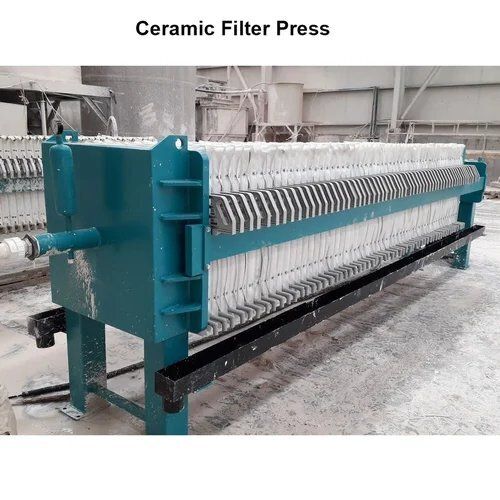
Versatile Plate Sizes and CustomizationOur ceramic filter presses can be tailored to meet your specific filtration needs, offering standard plate sizes from 500x500 mm up to 1250x1250 mm, as well as fully customized options upon request. Variable cake thickness, filter areas, and flow rates make them adaptable to a wide variety of industrial applications.
High-Performance Filtration for Industrial ApplicationsDesigned to handle challenging slurries like clay, kaolin, and ceramic, this press operates at pressures up to 1.6 MPa and temperatures up to 90C. Its advanced sealing, robust frame materials, and reliable mechanical components ensure high efficiency and consistent output, all while maintaining low energy consumption.
Service, Safety, and SupportWith both on-site and remote technical assistance available, our ceramic filter presses are user-friendly and dependable. Safety features include mechanical interlocks, pressure relief valves, and emergency stop systems. Comprehensive spare part support ensures minimal downtime and smooth operation wherever installed.
FAQ's of Ceramic Filter Press:
Q: How does the ceramic filter press operate for liquid/solid separation?
A: The ceramic filter press uses a series of high-strength ceramic plates and filter media to separate liquids from solids under pressure (up to 1.6 MPa). Slurry is pumped into the press, where solids form a cake between the plates, and filtered liquid passes through into collection channels.
Q: What industries and materials can benefit from this filter press?
A: It is ideal for processing ceramic slurry, clay, kaolin, and treating industrial effluents. Industries such as ceramics manufacturing, wastewater treatment, and mining benefit from its efficient, robust operation and customizable design.
Q: When should I choose gasketed or non-gasketed plates?
A: Gasketed plates offer superior sealing and are best for applications requiring minimal leakage, handling hazardous materials, or processes with stricter safety requirements. Non-gasketed plates are suitable for less critical applications where some leakage is acceptable.
Q: Where can the filter press be installed and what are the installation requirements?
A: The filter press requires a level foundation and utility connections (electric power, feed pump connections). It can be installed in industrial environments, processing plants, or treatment facilities, with frame materials (mild steel/SS) chosen to suit the site conditions.
Q: What is the process for cake discharge and can it be automated?
A: Cake discharge can be handled either manually or automatically depending on configuration. Automatic discharge speeds up the cycle, reduces labor, and is recommended for large-scale or continuous operations, while manual discharge is suitable for smaller setups.
Q: How does the filter press contribute to energy savings and environmental compliance?
A: High filtration efficiency reduces energy consumption per ton of processed slurry. The system operates below 75 dB, minimizes waste through efficient separation, and supports compliance with environmental standards for industrial effluent or process water recycling.
Q: What service support and spare parts are available for maintenance?
A: We provide on-site or remote technical assistance according to service agreements, and offer spare parts for all key components based on the manufacturer's specifications. This ensures reliable performance and reduces downtime during maintenance or unexpected repairs.






 Send Inquiry
 Send Inquiry
 Send SMS
 Call Me Free


 English
 Spanish
 French
 German
 Italian
 Chinese (Simplified)
 Japanese
 Korean
 Arabic
 Portuguese