Product Description
Product details
|
Brand
|
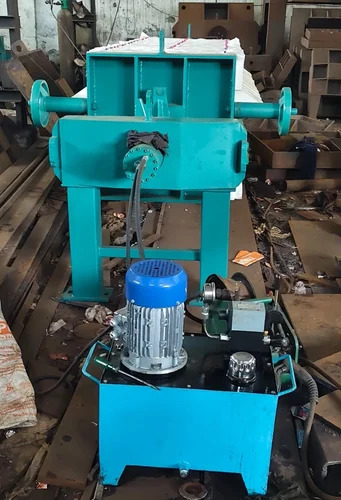
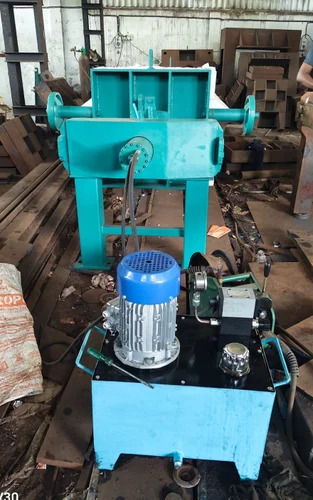
Om Sai Filter Press
|
|
Country of Origin
|
Made in India
|
|
Shape
|
Rectangle
|
|
No Of Plates
|
20
|
|
Filtration Capacity
|
1000 litres/hr
|
|
Automation Grade
|
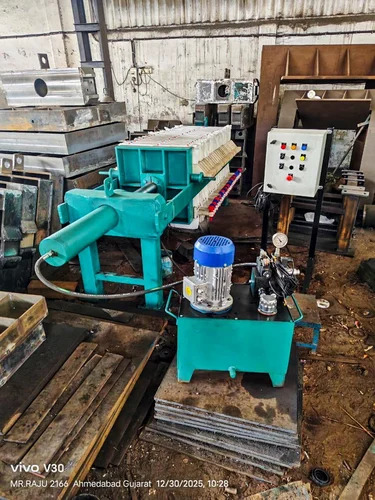
Automatic
|
|
Voltage
|
240 V
|
|
Body Material
|
MS
|
|
Usage/Application
|
For Liquid/Solid Separation
|
Key Features
- Cost-effective filtration solution for small industries
- Heavy-duty construction for long durability
- Easy manual operation and maintenance
- Ideal for sludge dewatering and chemical processing
- High filtration efficiency with clear filtrate
- Compact design for space-saving installation
Benefits
- Low initial investment with high ROI
- Minimal maintenance requirements
- Suitable for batch processing operations
- Versatile across multiple industries
- Easy to operate with minimal training
| Filter Press Size |
Chambers |
Cake (mm) |
Area (m2) |
Vol (L) |
L (mm) |
W (mm) |
H (mm) |
Wt (kg) |
| 300 |
12 |
32 |
1.68 |
22.8 |
1480 |
|
|
|
| 470 |
18 |
32 |
6.12 |
85.32 |
1950 |
830 |
710 |
275 |
| 610 |
24 |
32 |
14.40 |
207 |
2380 |
1050 |
1200 |
1300 |
| 610 |
24 |
40 |
15.12 |
261 |
2570 |
1050 |
1200 |
1300 |
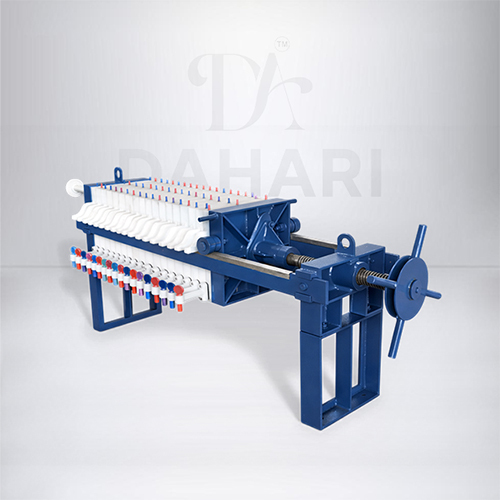
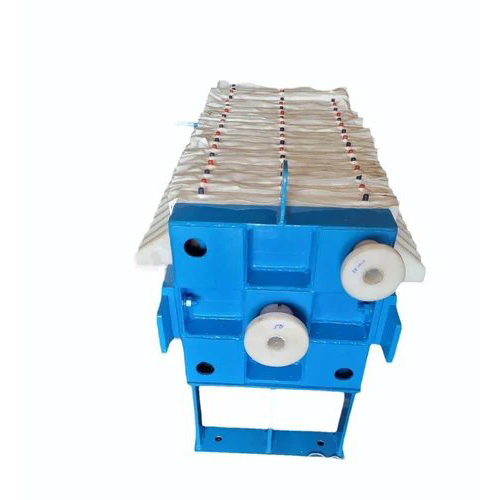
Robust Manual OperationWith its heavy-duty steel construction and manual screw jack mechanism, this filter press is built for durability. The hand wheel driven process provides precise control, allowing operators to easily manage the filtration cycle and ensure effective closure. Its robust build minimizes wear and supports longevity.
Customizable for Varied ApplicationsAvailable in sizes from 300mm to 610mm, this manual plate and frame filter press can be tailored to meet a range of liquid-solid separation needs. The number of plates, filter area, and flow rate are adaptable, making it ideal for both industrial routines and smaller-scale processes.
Effortless Maintenance and OperationThe design features simple plate removal for easy cleaning and maintenance. Since the frame is constructed from high-strength steel and uses no motors or electronics, ongoing maintenance is minimal. All operations are performed manually, making it user-friendly and reducing operation costs.
FAQ's of Manual Filter Press:
Q: How does the manual filter press operate?
A: This filter press operates by manually turning the hand wheel, which activates a screw jack mechanism to apply pressure and secure the plates. Liquid is pumped between the plates, and solids are retained on the filter media. When filtration is complete, plates can be easily removed for cleaning.
Q: What types of applications are suitable for this manual filter press?
A: It is suitable for a wide range of liquid-solid separation tasks in industries such as chemicals, food processing, and wastewater treatment. Its customizable capacities and plate configurations make it adaptable to both small- and medium-scale requirements.
Q: When should you consider using a manual plate and frame filter press?
A: A manual filter press is best chosen when you require affordable, reliable, and straightforward liquid-solid separation without the need for automation or electricity beyond basic pumping. It's ideal for operations prioritizing simplicity and low maintenance.
Q: Where is this manual filter press manufactured and supplied from?
A: This filter press is manufactured and supplied by experienced exporters, manufacturers, and suppliers based in India, ensuring local support and expertise for Indian and international customers.
Q: What is the process for maintaining the manual filter press?
A: Maintenance is straightforward: after filtration, the plates can be manually removed, cleaned, and reassembled. Regular inspection of the screw jack, plates, and seals ensures optimal function and longevity of the equipment.
Q: How customizable is the capacity and size of the filter press?
A: The filter press can be customized by selecting the plate size (ranging from 300mm to 610mm) and the number of plates needed, allowing you to tailor the capacity and filter area to your specific application.
Q: What are the main benefits of using this manual filter press?
A: Key advantages include robust steel construction, ease of operation and maintenance, adaptability to various capacities, and cost savings from minimal automation. Its manual design is reliable and ideal for environments where electricity is limited or simple operation is preferred.






 Send Inquiry
 Send Inquiry
 Send SMS


 English
 Spanish
 French
 German
 Italian
 Chinese (Simplified)
 Japanese
 Korean
 Arabic
 Portuguese